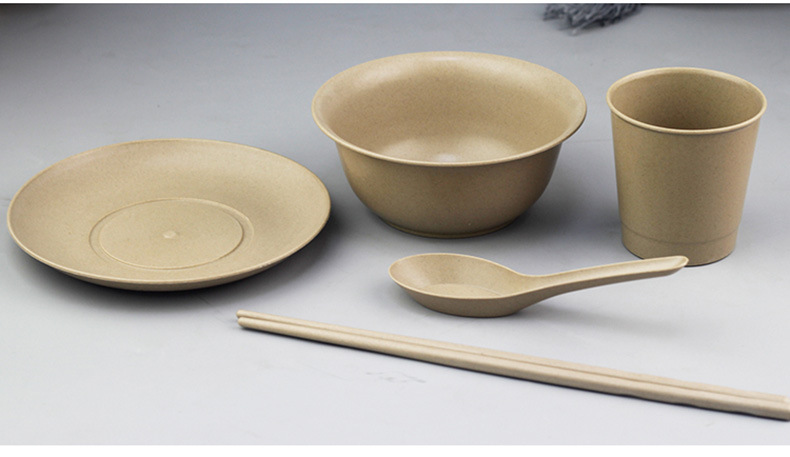
Rice husks are the outer hard shells remaining after rice is threshed. They are naturally rich in silicon, cellulose, and lignin, and are insoluble in water, resistant to acids and alkalis, and free of free toxins. After being processed through a high-temperature and high-pressure molding process, they can completely remove impurities and microorganisms, while retaining the plant fiber structure and forming a dense and pore-free surface – this is precisely the core reason why it can comply with the GB 4806.7-2016 standard for food-contact plastic materials and products.
Rice husk tableware is usually made by combining rice husk fibers with adhesives (such as PP, PLA, melamine, etc.). The material composition complies with the FDA food contact material regulations. It does not mold, has no odor, and is a healthy, environmentally friendly, and reusable natural plant fiber tableware.
Some businesses, in an attempt to avoid the potential food safety risks and liability associated with cleaning and disinfecting public tableware themselves, have chosen to use disposable plastic tableware. Among these, many are so-called pseudo-eco-friendly rice husk tableware. Some of the rice husk tableware are actually composite materials made of plant fibers and melamine resin or plastic. Under high temperatures or acidic conditions, they are prone to releasing harmful substances such as formaldehyde and melamine. Long-term exposure may increase the risk of cancer. These tableware release harmful substances when used and the discarded waste from them seriously pollutes the environment. Investigations have found that these tableware are all re-packaged in unhygienic conditions and are not disinfected, thus posing a risk of virus transmission. Most of the “rice husk tableware” on the market contain about 20% of plastic components (such as PP polypropylene), and are not purely natural. Their degradation cycle is also longer.
Rice husk tableware is classified as a “food contact substance”. The FDA defines food contact materials as: materials and products that are expected to come into contact with food under normal usage conditions. The rice husk tableware (bowls, plates, chopsticks, lunch boxes) directly comes into contact with food. The chemical components in it may migrate into the food, so it is subject to strict regulation by the FDA. The material of the rice husk tableware has a high density, is not prone to harboring bacteria, and can naturally degrade in the outdoor environment after being discarded. It is an ideal substitute for traditional plastic tableware and is a revolutionary new generation of environmentally friendly products!