
The era of the static poster is officially over. Once a simple tool for displaying rotating menus or lobby announcements, digital signage has evolved into a dynamic, intelligent, and deeply personal communication medium. It sits at the intersection of the physical and digital worlds, and thanks to rapid technological advancements, it’s no longer just a screen on a wall.
Whether you’re a retailer, a corporate communications manager, or a solutions provider, ignoring these shifts means leaving engagement, data, and revenue on the table. Here are six trends that are fundamentally reshaping the future of digital signage.
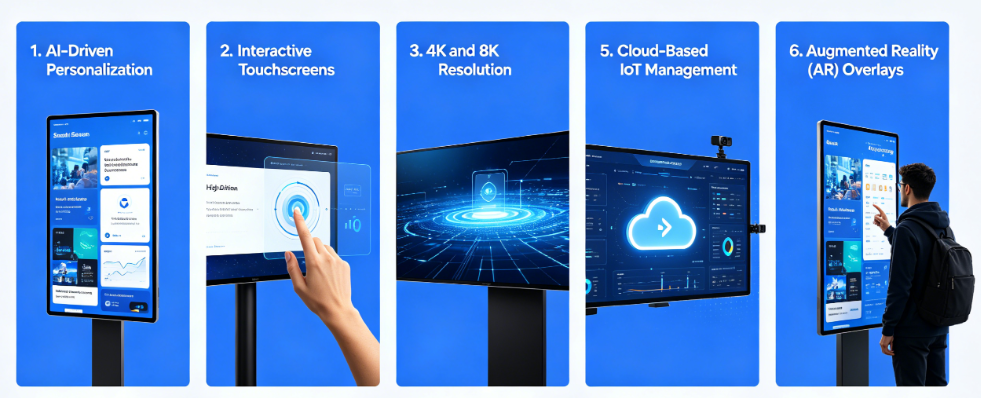
Table of Contents
1. AI-Powered Hyper-Personalization
Generic content loops are becoming a relic of the past. Artificial intelligence is now the engine driving true one-to-one communication in public spaces. With real-time audience detection—using anonymous video analytics, not facial recognition that stores personal data—screens can now adapt content based on the viewer’s demographics, dwell time, and even mood.
Imagine a quick-service restaurant drive-thru menu that auto-suggests a hearty breakfast burrito to a tired-looking commuter, or a refreshing iced coffee on a hot day. The content is triggered by real-time context. The result? Sharply higher engagement, reduced perceived wait times, and a dramatic increase in upsell conversions. This isn’t science fiction; it’s the natural union of digital signage and edge-based AI inference.
2. The Rise of Programmatic DOOH (pDOOH)
The Out-of-Home advertising industry is undergoing a programmatic revolution. No longer are advertisers forced to book static campaigns months in advance with no flexibility. Programmatic DOOH allows for the automated buying, selling, and delivery of ads on digital screens based on real-time triggers.
A swimwear brand can automatically book thousands of screens across a city the moment the temperature hits 30°C. A food delivery app can push ads to transit shelters right when the evening rush hour begins. For network owners, pDOOH unlocks entirely new revenue streams by filling remnant ad slots with premium programmatic demand. For buyers, it brings digital-style measurability and agility to the physical world.
3. Seamless Interactivity and Touchless Engagement
The post-pandemic world didn’t kill touchscreens, but it accelerated the demand for touchless alternatives. The future of interaction is multi-modal. We’re seeing a surge in voice-activated wayfinding kiosks, gesture-controlled directories, and most importantly, QR-code and NFC-driven “bridge” experiences.
Shoppers scan a product on a display, complete the purchase on their phone, and have it delivered to their home. Event attendees tap their badge on a wayfinding screen, and it instantly shows a personalized agenda route. The digital signage screen becomes the starting point for a mobile journey, creating a seamless data loop that connects the physical interaction with the online customer profile.
4. Data-Driven, Real-Time Content Automation
The best digital signage networks feel alive. They respond to the world around them, and that’s only possible with tightly integrated, real-time data sources. This goes far beyond basic weather triggers. Modern CMS platforms are pulling in live sports scores, breaking news headlines, social media feeds, local transit ETAs, inventory levels, and point-of-sale data to dynamically populate content.
A clothing store’s window display can automatically feature a specific jacket trending on Instagram in that exact neighborhood. A corporate cafeteria menu board can auto-dim an item when it sells out. This “content as a stream” approach eliminates the bottleneck of manual updates, keeping every screen relentlessly relevant and context-aware.
5. Sustainability as a Core Feature, Not an Afterthought
As ESG requirements tighten, the sustainability of digital signage is moving from a “nice-to-have” to a mandatory purchase criterion. The trend is twofold: hardware with dramatically lower energy consumption and software that enables intelligent power management.
E-paper and reflective LCD technologies, which use ambient light instead of a power-hungry backlight, are making outdoor and transit displays viable with a solar panel and a small battery. Meanwhile, built-in scheduling allows entire networks to dim or sleep based on store hours or pedestrian presence, drastically reducing electricity costs and carbon footprints. The pitch is evolving from “brightness” to “efficiency without compromise.”
6. The “System-on-Chip” (SoC) Revolution
The era of the dedicated, bulky external media player is fading. The future is embedded. Modern commercial displays ship with powerful System-on-Chip processors running Android or Tizen operating systems right on the panel. Why is this transformative? It slashes hardware costs, eliminates multiple points of failure, simplifies installation, and dramatically reduces energy use.
For IT teams, it means managing a single smart screen rather than a screen, a player, a power brick, and a nest of cables. As these SoC platforms mature, they support the full range of modern web technologies, making it possible to deploy a powerful, interactive digital signage network simply by plugging in a screen and connecting it to Wi-Fi. Total cost of ownership drops, and scalability skyrockets.
The Digital Signage Experience Mandate
These six trends all converge on one central mandate: the screen exists to serve the viewer. Whether through personalization, interactivity, or real-time relevance, the technology is fading into the background while the experience takes center stage. The future isn’t just about brighter displays; it’s about smarter, more sustainable, and more human connections.